Technical readiness
What it evaluates
Crawlability, security, delivery, indexation
Why AI systems care
AI cannot cite pages it cannot reliably fetch and parse

An AI Readiness Assessment measures whether your website is prepared for AI-mediated discovery, across ChatGPT, Gemini, Claude, Perplexity, and Google AI Overviews. This guide explains the score, the seven readiness pillars, and how to act on the results.
Buyers no longer begin with ten blue links. They ask AI which brand to trust, and accept the answer as a shortlist. An AI Readiness Assessment measures whether your website is prepared for that moment: discoverable, interpretable, and recommendable across ChatGPT, Gemini, Claude, Perplexity, and Google AI Overviews.
This guide explains what an AI Readiness Assessment is, how it differs from a traditional SEO audit, what the score actually means, and how marketing and ecommerce leaders should use the results. It is written for directors who need clarity without hype, and who suspect their organic performance does not tell the whole story about AI visibility.

Search engine optimization remains essential. Indexation, crawl health, page experience, and relevance still determine whether your pages exist in the retrieval layer AI systems draw from. But ranking on page one and being recommended in an AI answer are not the same outcome.
We routinely audit premium brands with strong organic traffic and weak generative presence. They appear in Search. They are absent when a buyer asks ChatGPT for the best option in their category. The gap is not a failure of effort. It is a failure of measurement: teams optimized for clicks while discovery moved upstream into conversational and synthesized answers.
Google's own guidance on AI features in Search emphasizes familiar SEO fundamentals as the foundation for AI experiences. That is accurate, and incomplete for brands competing on ChatGPT, Perplexity, and Gemini, where retrieval mechanics and recommendation logic differ. You need a diagnostic built for the full AI search landscape, not only for position tracking.
AI Readiness describes how prepared your website and brand presence are for AI-mediated discovery. It answers a practical question: if an AI system tries to understand, cite, or recommend you today, what evidence does it find, and how confident can it be?
Definition
AI Readiness = the measurable degree to which your site provides the technical, structural, entity, and content signals that modern AI search systems need to represent your brand accurately in answers and recommendations.
This is distinct from organizational AI readiness: a term common in enterprise consulting for internal AI adoption, data governance, MLOps, talent, and change management. Those assessments answer whether your company can deploy AI inside the business. Website AI Readiness answers whether external AI systems can represent you correctly to customers. Both matter. They are not interchangeable.
At FutureFox Labs, we use AI Readiness as the baseline for AI Search Visibility programs: the point where SEO foundation, Answer Engine Optimization, and Generative Engine Optimization converge. Without a readiness baseline, teams debate tactics without shared facts.
No major AI platform publishes a full scoring rubric. Behavior is observable, though. Across ChatGPT, Gemini, Claude, Perplexity, and Google AI Overviews, the same categories of evidence recur when systems move from retrieving information to naming a brand.
Modern assistants combine trained knowledge with live retrieval. When browsing or search is enabled, models pull fresh sources at query time. That means your current web presence matters, not only historical authority. Pages blocked by robots.txt, rendered only client-side, or missing from your sitemap may never enter the evidence set.
AI systems resolve brands as entities: Organization, Product, Person, Place. Ambiguous naming, conflicting descriptions across retailers, or missing structured data create entity confusion, the model cites the wrong business or omits you entirely. Entity optimization is often the highest-leverage readiness work for premium brands.
Answer engines favor content they can quote cleanly: clear headings, self-contained paragraphs, explicit comparisons, and facts stated in prose, not trapped in images or scripts. Google AI Overviews draw from indexed content; Perplexity and ChatGPT with search behave similarly. Structure is not decoration. It is retrieval infrastructure.
Reviews, expert mentions, press coverage, and consistent brand descriptions across authoritative surfaces influence recommendation confidence. AI does not replace trust signals. It synthesizes them. Thin or contradictory external evidence weakens your position in category shortlists.
Short answer
AI systems evaluate whether they can reach your pages, identify your brand, extract useful facts, and trust the evidence enough to recommend you, in that order.
A useful assessment organizes findings into pillars leadership can act on. FutureFox maps readiness across seven categories, each tied to deterministic checks, not subjective opinion.
The seven pillars of website AI Readiness
Technical readiness
What it evaluates
Crawlability, security, delivery, indexation
Why AI systems care
AI cannot cite pages it cannot reliably fetch and parse
Metadata readiness
What it evaluates
Titles, descriptions, social and page-level tags
Why AI systems care
Tells systems what each URL is about before deep parsing
Structured data readiness
What it evaluates
JSON-LD schema for Organization, Product, FAQ, and related types
Why AI systems care
Lets machines read entities and relationships without guessing
Content readiness
What it evaluates
Depth, structure, clarity, and citation-friendly formatting
Why AI systems care
Determines whether facts can be extracted and quoted accurately
Trust readiness
What it evaluates
Authority, credibility, and consistency signals
Why AI systems care
Influences whether AI treats your brand as a safe recommendation
Entity readiness
What it evaluates
Brand coherence across site and wider graph
Why AI systems care
Prevents misattribution and strengthens category positioning
AI visibility readiness
What it evaluates
Answer-first architecture, question coverage, citation patterns
Why AI systems care
Shapes eligibility in generative answers and shopping comparisons
The seven pillars of website AI Readiness
| Pillar | What it evaluates | Why AI systems care |
|---|---|---|
| Technical readiness | Crawlability, security, delivery, indexation | AI cannot cite pages it cannot reliably fetch and parse |
| Metadata readiness | Titles, descriptions, social and page-level tags | Tells systems what each URL is about before deep parsing |
| Structured data readiness | JSON-LD schema for Organization, Product, FAQ, and related types | Lets machines read entities and relationships without guessing |
| Content readiness | Depth, structure, clarity, and citation-friendly formatting | Determines whether facts can be extracted and quoted accurately |
| Trust readiness | Authority, credibility, and consistency signals | Influences whether AI treats your brand as a safe recommendation |
| Entity readiness | Brand coherence across site and wider graph | Prevents misattribution and strengthens category positioning |
| AI visibility readiness | Answer-first architecture, question coverage, citation patterns | Shapes eligibility in generative answers and shopping comparisons |
These pillars mirror the framework in our enterprise ecommerce checklist, scaled for any brand that depends on AI-mediated discovery, not only enterprise catalogs. Weakness in any single pillar can cap outcomes elsewhere: perfect schema cannot compensate for blocked crawlers; strong content cannot fix entity fragmentation.
The pattern is consistent: teams optimize what they already measure. Until AI Readiness is measured with the same rigor as rankings, gaps persist in silence.
Measurement should combine automated signal analysis with structured prompt testing. Neither alone is sufficient.
Run deterministic checks across technical, metadata, schema, content, trust, entity, and AI visibility dimensions. The output should be reproducible: the same URL should yield the same findings, with category scores and prioritized recommendations. Avoid tools that return a black-box AI opinion with no evidence trail.
Define twenty to thirty category questions your brand should win, "best [product] for [use case]," "[brand] vs [competitor]," "where to buy [category]." Test them periodically across ChatGPT, Gemini, Claude, and Perplexity. Track whether your brand is mentioned, how it is described, and whether your URLs are cited. Our guide on ecommerce visibility across generative engines details platform nuances.
For Google surfaces, monitor AI Overview impressions and cited URLs via Search Console where available. Declining citation share while rankings hold steady is an early warning, a readiness problem masquerading as stable SEO.
Practical baseline
Start with an automated AI Readiness Assessment for objective scores, then layer prompt testing for competitive context. Leadership gets a number and a narrative; practitioners get a fix list.
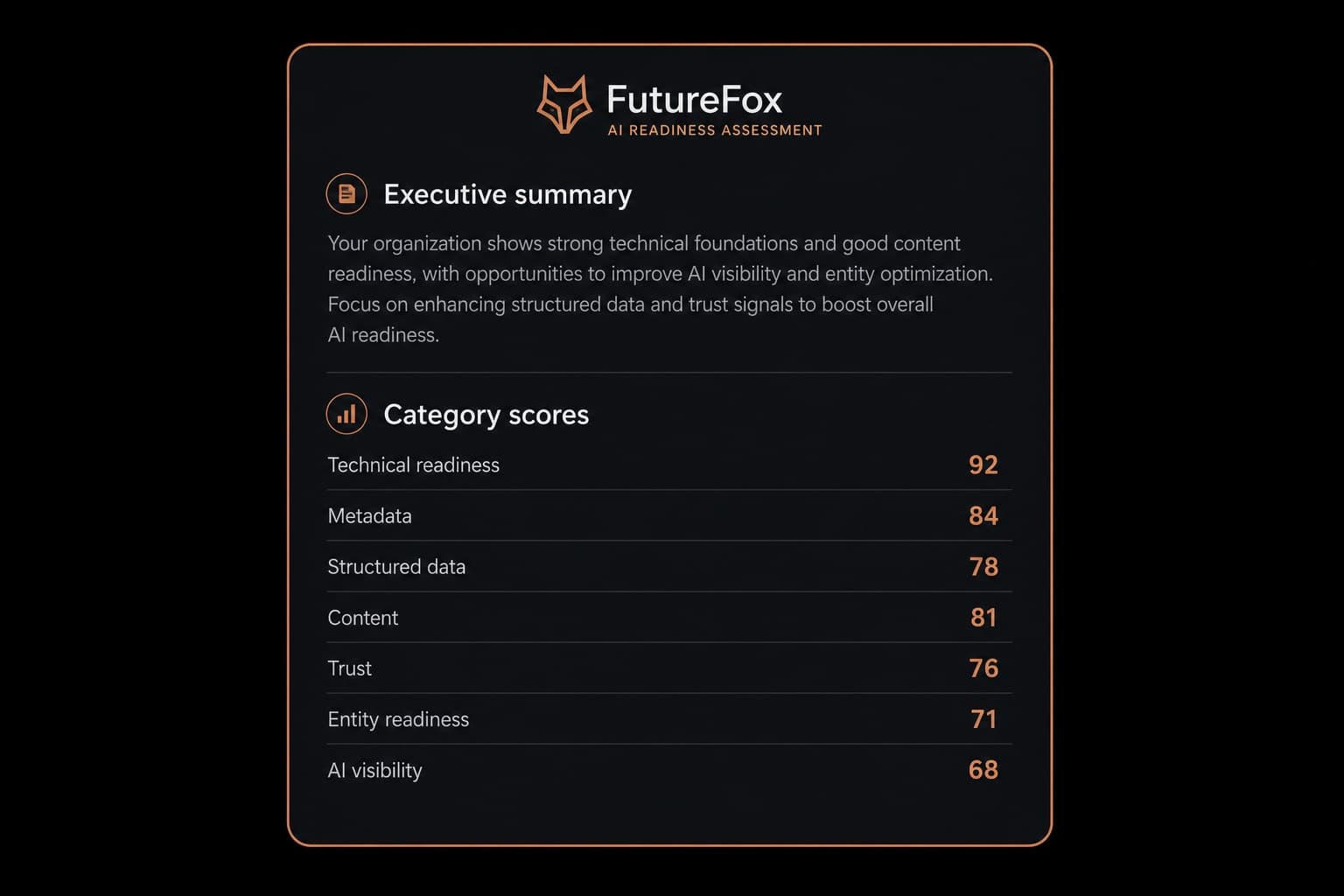
A single AI Readiness Score is useful for executive alignment. It is dangerous as the only output. "72 out of 100" does not tell an engineering team what to ship Monday morning.
A credible assessment delivers:
Aggregate scores also hide critical weaknesses. A site can score well on technical readiness while failing entity readiness, still invisible in category recommendations. Always read the pillar view.
A standard website assessment follows a predictable flow, regardless of vendor.
The entire automated pass can complete in seconds. Value accrues when the output is specific enough to drive a sprint, not when it produces a vanity badge.
How AI Readiness compares to adjacent audits
Traditional SEO audit
Primary question
Can we rank and earn organic traffic?
Best for
Search foundation and crawl health
Technical SEO audit
Primary question
Are there blocking technical errors?
Best for
Engineering remediation lists
AI Readiness Assessment
Primary question
Can AI systems understand and recommend us?
Best for
AI Search Visibility baseline
GEO program review
Primary question
How do we shape AI recommendations over time?
Best for
Ongoing recommendation strategy
Organizational AI readiness
Primary question
Can we deploy AI inside the business?
Best for
Internal AI transformation planning
How AI Readiness compares to adjacent audits
| Audit type | Primary question | Best for |
|---|---|---|
| Traditional SEO audit | Can we rank and earn organic traffic? | Search foundation and crawl health |
| Technical SEO audit | Are there blocking technical errors? | Engineering remediation lists |
| AI Readiness Assessment | Can AI systems understand and recommend us? | AI Search Visibility baseline |
| GEO program review | How do we shape AI recommendations over time? | Ongoing recommendation strategy |
| Organizational AI readiness | Can we deploy AI inside the business? | Internal AI transformation planning |
These audits stack. Skipping SEO undermines everything upstream. Stopping at SEO leaves generative visibility unaddressed. AI Search Optimization is the operating model that connects them with shared measurement.
The FutureFox AI Readiness Assessment is a free, deterministic evaluation built for premium brands competing in AI-mediated discovery. It runs 57 checks across the seven readiness pillars, no simulated AI scores, no generated guesses. Every recommendation ties to a measurable signal on your site.
The assessment delivers an AI Readiness Score, readiness level, executive summary, AI visibility impact classification, category scores, strengths, risks, and prioritized recommendations. After review, teams can request an Executive Assessment Report with a 30-day roadmap, and optionally work with FutureFox consultants to sequence implementation across capabilities engagements.
We built the assessment because generic SEO tools do not answer the question executives now ask: *Are we visible where buyers actually decide?* The score is the entry point. The pillar breakdown and roadmap are the product.
Readiness work follows a sensible sequence. Fix blocking technical and crawl issues first. Consolidate entity signals and schema on revenue-critical templates. Publish or restructure comparison and FAQ content for extraction. Expand prompt testing to verify movement. Re-assess quarterly or after major releases.
If scores are flat despite internal effort, or if entity fragmentation spans regions and retailers, external expertise accelerates alignment. A strategy conversation after your baseline is often the fastest path from diagnosis to a funded workstream.
An AI Readiness Assessment is a structured evaluation of how prepared your website is to be discovered, understood, cited, and recommended by AI search systems, including ChatGPT, Gemini, Claude, Perplexity, and Google AI Overviews. It measures technical crawlability, metadata, structured data, content quality, trust signals, entity clarity, and AI-specific visibility factors. It is not the same as an organizational AI adoption audit, which evaluates internal data, governance, and talent for deploying AI inside your company.
An AI Readiness Score is a weighted 0–100 rating that summarizes how reliably AI systems can interpret and recommend your brand based on measurable website signals. A strong score usually means solid technical foundation, clear entity definition, and citation-ready content. A low score highlights specific gaps, such as missing schema, weak metadata, or thin product evidence, that block AI visibility even when traditional SEO rankings look healthy.
A traditional SEO audit focuses on rankings, crawl health, and organic traffic. An AI Readiness Assessment adds layers that matter for generative engines: entity resolution, answer-first content structure, structured data completeness, trust and citation signals, and how your brand appears when buyers ask AI for recommendations. Many sites pass a classic SEO audit but still fail AI retrieval because machines cannot confidently name the brand in synthesized answers.
Organizational AI readiness measures whether a company can adopt AI internally, data pipelines, governance, talent, and culture. Website AI Readiness measures whether external AI systems can represent your brand accurately to customers. Both use similar language, but they answer different questions. FutureFox focuses on the external layer: AI Search Visibility, Answer Engine Optimization (AEO), and Generative Engine Optimization (GEO).
A credible assessment evaluates seven pillars: technical readiness (crawlability and delivery), metadata readiness (titles and descriptions), structured data readiness (schema and machine-readable entities), content readiness (depth and extractability), trust readiness (authority signals), entity readiness (brand coherence across the web), and AI visibility readiness (answer-first structure and citation potential). The FutureFox AI Readiness Assessment runs 57 deterministic checks across these dimensions.
A automated website assessment typically completes in under a minute once a URL is submitted. The value is in the diagnostic depth: category scores, prioritized recommendations, and an executive summary you can share with leadership. Deeper consultant-led reviews, covering competitive prompt panels and implementation sequencing, follow the baseline and are scoped separately.
Run a baseline assessment before major SEO or site projects, after replatforms, and quarterly if AI-mediated discovery is a strategic priority. Re-assess when you launch new markets, rebrand, or see flat recommendation share despite organic growth. AI systems retrieve live web content; readiness is not a one-time certification.
Scores above 85 indicate strong structural readiness with refinement opportunities. Scores between 70 and 84 suggest solid foundation with identifiable gaps limiting recommendation confidence. Scores below 70 signal foundational work is needed before advanced GEO tactics will compound. Context matters: compare your score to category peers and focus on the lowest-scoring pillars, not the headline number alone.
Often, yes. Many improvements are metadata, schema, entity consolidation, and content restructuring, not full replatforms. Quick wins include Organization and Product schema on hero pages, consistent brand naming, FAQ and comparison content formatted for extraction, and robots.txt policies that allow reputable AI crawlers. The assessment prioritizes by impact and effort so teams know what to fix first.
AI Readiness is the diagnostic foundation. Answer Engine Optimization (AEO) structures content so AI can quote you accurately in synthesized answers. Generative Engine Optimization (GEO) shapes which brand AI recommends. AI Search Optimization unifies all three. An assessment tells you which layer needs investment first.
Credible assessments should not. FutureFox uses deterministic technical and content analysis, measurable signals such as schema presence, metadata quality, heading structure, and entity markers, rather than asking a language model to guess your visibility. That produces reproducible results leadership can trust and engineering can act on.
Request a review when the score reveals cross-functional gaps (entity fragmentation, schema governance, content architecture), when recommendation share is flat despite SEO investment, or when leadership needs a prioritized roadmap before budgeting GEO work. The AI Readiness Assessment includes an executive report; a strategy session helps sequence fixes across teams.
Key takeaways
An AI Readiness Assessment is how modern brands answer a new strategic question: when a buyer asks AI what to choose, will our name appear, accurately, credibly, and often? Traditional SEO remains the foundation. It no longer guarantees visibility in the recommendation layer where purchase decisions increasingly begin.
Measure readiness across technical access, metadata, structured data, content extractability, trust, entity clarity, and AI-specific visibility. Use the score to align leadership. Use the pillar breakdown to prioritize work. Test the prompts that define your category to confirm progress.
When you are ready to baseline your position, run the free AI Readiness Assessment, explore our research library, or contact FutureFox Labs to review findings with a consultant. The brands that invest in readiness now compound citation and entity advantages that are difficult to displace later.
Run a free AI Readiness Assessment in under 60 seconds. See exactly where you stand, then book a complimentary strategy session if you want to act on the findings.
Score first. Strategy session when you are ready.
FutureFox Research
Receive FutureFox's original AI Search research, industry benchmarks and AI Visibility reports. No spam. Only research worth reading.
Join digital leaders following AI Search, GEO and Answer Engine Optimization research.